How to sort Pokémon bulk
Published
Sort Pokémon bulk by rarity, not by set or type. Four piles do it: set aside basic energy and code cards, pull the ex, V and other higher rarities, split the holos and reverse holos from the rest, and what is left is commons and uncommons. At our rates, that turns 1,000 cards worth $10.00 unsorted into $42.65.
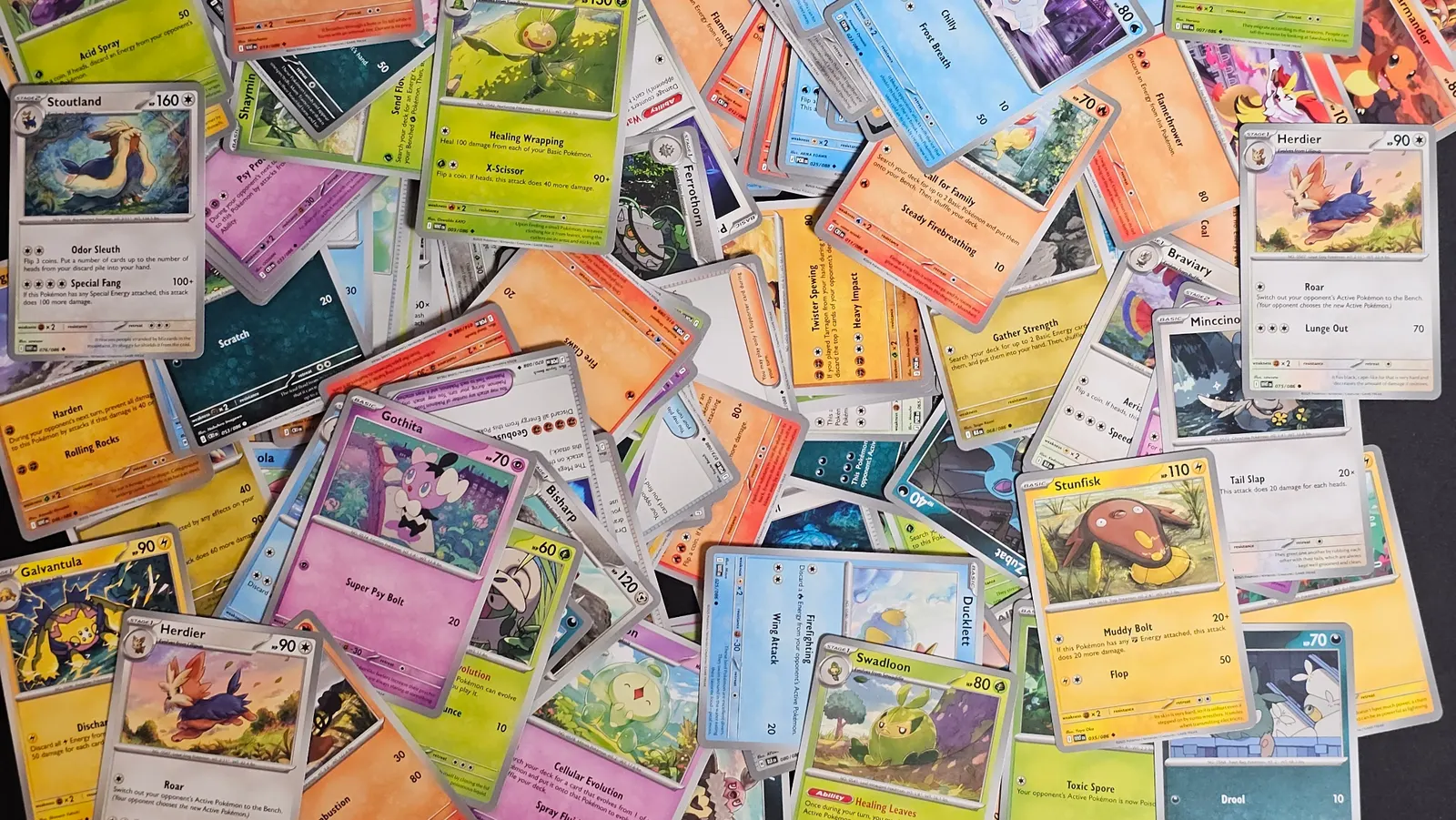
Sort by rarity, not by set
Bulk is priced by rarity, so rarity is the only sort that pays. You do not need to split cards by set, by type or by Pokémon, and every pile can mix old and new sets. Sorting by set is useful if you plan to look cards up or build decks, but it does not change what bulk is worth.
The four piles, in order
Pick up each card once and ask these questions in this order. The first one that fits decides the pile.
- Set aside basic energy and code cards. They do not go in sorted rows. Basic energy can still go in an unsorted box.
- Pull the higher rarities. Any card whose name ends in ex, EX, GX, V, VMAX or VSTAR, any full art Pokémon or trainer, and any alt art, illustration rare, gold or rainbow card. These are paid one by one, from 60 cents each up, so they are worth the most per minute of sorting.
- Split out the foil. A holo has a shiny picture. A reverse holo has a shiny card with a plain picture. Both go in one pile at $50 per 1,000.
- The rest is commons and uncommons, at $20 per 1,000.
How to read the rarity symbol
Every card has a small rarity symbol near the bottom, next to the card number. A circle is a common and a diamond is an uncommon; those two share a pile. A single black star is a rare: if it has foil, it goes with the holos. More than one star, or a gold or silver star, means a higher rarity, which goes in the per-card pile.
What each step is worth
Say your pile is 1,000 cards: 820 commons and uncommons, 150 holos and reverse holos, 25 ex, V and GX cards, and 5 full arts. At our published rates:
| How far you sort | The work | You get |
|---|---|---|
| Not at all | Every card at $10 per 1,000. | $10.00 |
| Hits pulled | Steps 1 and 2. The other cards go in unsorted. | $28.45 |
| Fully sorted | All four steps. | $42.65 |
Pulling 30 cards is most of the gain: $18.45 more for the few minutes it takes. The foil split adds $14.20 more and takes longer. You can stop after any step and send the rest unsorted in the same box.
Sorted your pile? Enter the count for each category on Sell Your Bulk and see your total before you ship anything.
Price My BulkCount as you go
You enter a count for each pile when you price your bulk, and we pay on our own count of the box, so a careful count means the total you see is close to the total you get. A quick way: count one stack of 100 exactly, then match the height of the other stacks against it. Count the per-card pile one by one, since every card in it is paid separately.
Keep the piles apart in the box
Pack each category in its own rows, standing on edge, with a strip of cardboard between every row. Never use rubber bands: we buy Near Mint cards only, and a card marked by a band is one we cannot pay for. The packing guide on Sell Your Bulk shows each step.
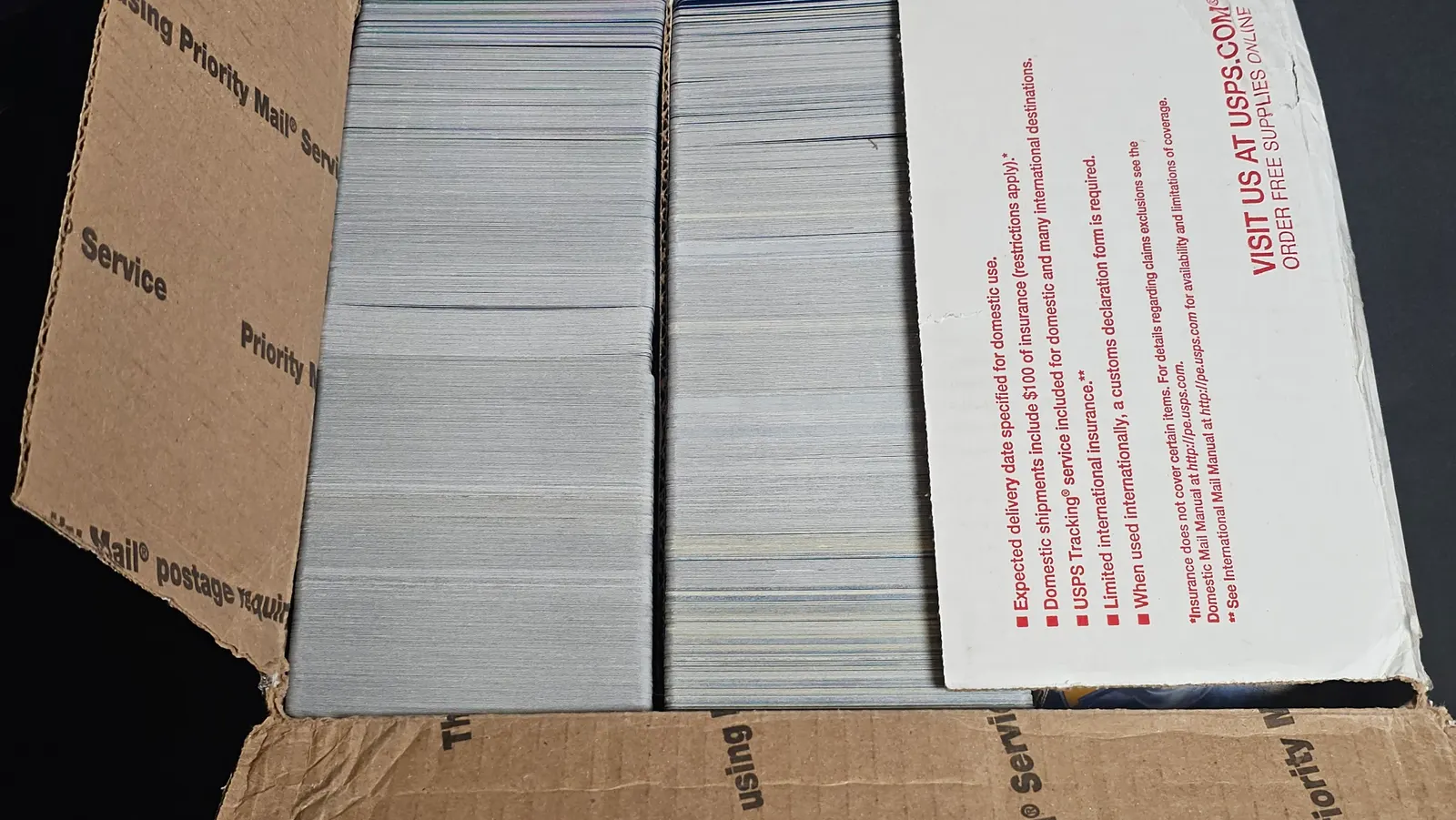
What a sorted box is worth
For what a whole box pays at each level of sorting, see how much Pokémon bulk is worth.
Questions
- Do I need to sort Pokémon bulk by set?
- No. Bulk is priced by rarity, so sort by rarity only. Each pile can mix cards from any set, old or new.
- Where do basic energy cards go?
- Keep them out of sorted rows. Basic energy is fine in an unsorted box.
- Is it worth sorting bulk at all?
- Pulling the ex, V and other higher rarities is worth it for almost any pile, since those are paid per card. The foil split pays less for the time. You can stop after any step and send the rest unsorted in the same box.